
A load that arrives perfect in Munich can arrive damaged in Dubai, even though it left the same warehouse. It is not a question of distance: a container goes through conditions a curtain-side truck never meets. Preparing timber for sea freight means thinking about the voyage before the goods.
What happens inside a container
A closed steel container in the sun behaves like a greenhouse. The inside temperature rises well above the outside one during the day and drops at night, and the cycle repeats for weeks. Warm air holds more vapour; when the temperature falls, that vapour condenses on the coldest surface available — typically the metal roof — and drips back onto the load.
It is what shippers call «container rain». The wood does not need to be wetted from outside to suffer the consequences: the moisture the load itself carries, released and condensed again cycle after cycle, is enough. The result is surface mould, discolouration and, in the worst cases, stains that penetrate the fibre.
The moisture of the wood is the first variable
The more moisture there is in the wood at departure, the more there is to release during the voyage, and the higher the risk. That is why timber bound for sea freight generally needs more thorough drying than timber sold by road within Europe, and above all an even moisture content across the whole pack.
Uniformity matters as much as the average value. A pack with the right average moisture but a few wetter boards in the middle behaves badly: those boards release vapour into a closed space and pass it on to the whole load. That is why moisture must be measured at several points of the thickness and in several places in the stack, not on a single sample.
The target value is not universal: it depends on the species, the thickness, the end use and the climate at destination. It must be agreed beforehand, not worked out afterwards.
Packing: what really protects
Instinct says: seal it. That is the most common mistake: a plastic film closed without dehumidification traps moisture instead of keeping it out, and turns the pack into a small condensation chamber. Packing for sea freight has to do two seemingly opposite things — shelter from free water and stop vapour from building up.
The solutions are well known and are combined case by case: breathable or ventilated covers, desiccants sized to the volume and water content of the load, barrier wraps applied only once the wood has already been brought to the right moisture. In every case packing works at the margin: it does not fix badly prepared wood.
“A sealed container of over-moist timber is the most effective way to deliver mould to the other side of the world.”
Alp Timber Group
How to stow
Layout matters too. The load must not touch the metal walls, where condensation is most likely; it must be raised off the floor to allow circulation; and it must be secured so it cannot move, because rubbing during the roll damages the ends and edges — the very parts that were worked on to protect them.
Centre of gravity and weight distribution are a safety issue before a quality one, and they follow the rules of sea transport, not the preferences of whoever is loading.
Phytosanitary requirements
Wooden packaging material used in international trade is subject to the ISPM 15 standard, which requires treatment and marking of the pallet or crate. It concerns the packaging, not necessarily the goods, but it must be checked for each destination together with any phytosanitary documentation the importing country may require, which varies and changes over time.
Document instead of hoping
A sea load spends weeks out of the control of whoever prepared it, and if there is a dispute the discussion moves to what happened during the voyage. The only way out is to have recorded the condition at departure: moisture measured at several points, type of packing, desiccants used, layout in the container.
This is not red tape. It is the difference between being able to prove that the material left in conformity and having to argue it. It also works the other way: if the problem began upstream, the data make it obvious at once and let you correct the cycle instead of repeating the mistake on the next load.
Road and sea, two different preparations
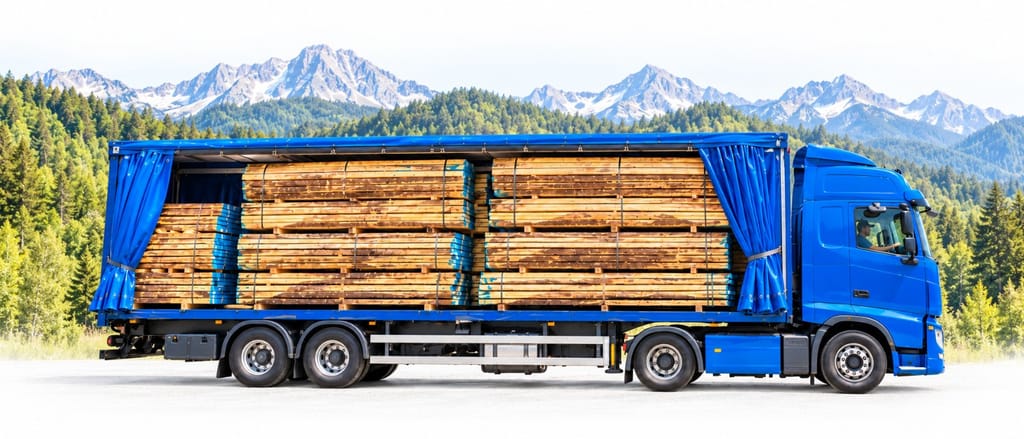
The group loads both curtain-side trucks for Europe and containers for sea freight directly on site. The European markets — Austria, Germany, Italy, Croatia, Hungary, Romania, Slovakia — almost always travel by road, with short transit times and predictable climate. Turkey, the United Arab Emirates, India, Vietnam and Mauritius instead mean long crossings and big temperature swings.
They are two different trades starting from the same warehouse. The full map of the twelve markets and the two modes of transport is on the page Markets.
Frequently asked questions
Why does timber go mouldy in a container even without leaks?
Because of internal condensation: the warm daytime air holds vapour that condenses on the metal at night and drips back onto the load. The moisture can come entirely from the wood itself.
Does sea freight need a lower moisture content?
Generally yes, and above all a more uniform one. The value depends on species, thickness, end use and climate at destination, and must be agreed before shipping.
Does sealing the pack in plastic film protect it?
Not on its own: without desiccants and without first bringing the wood to the right moisture, the film traps the vapour and makes things worse.
What is ISPM 15?
The international standard for wooden packaging material used in foreign trade: it requires treatment and marking. It concerns the packaging and must be checked for each destination.