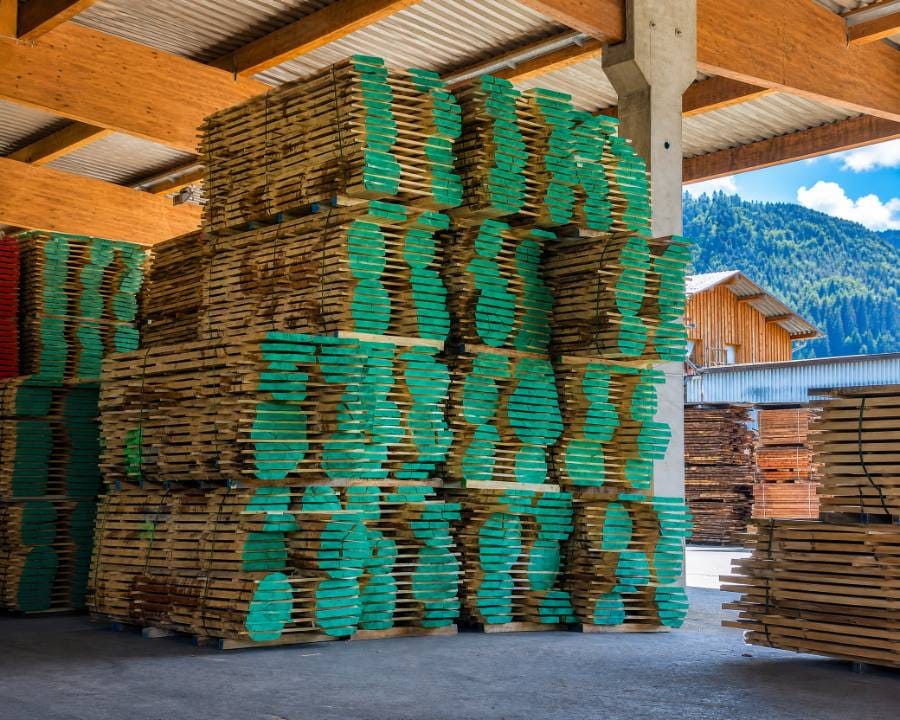
«FSC certified» appears on a great many sales documents, often without it being clear what exactly is being certified. It is not a mark of wood quality, and it says nothing about the yield or the look of a board. It says something different and just as concrete: that the origin of that material is documented along the whole chain.
What FSC means
FSC is the Forest Stewardship Council, an international non-governmental organisation that sets standards for responsible forest management. The system rests on two separate families of certificates, and that is where almost all the confusion starts.
Forest management
This concerns the forest. It certifies that a given forest area is managed according to the environmental, social and economic criteria defined by the standard: respect for its capacity to regenerate, protection of biodiversity, the rights of workers and local communities.
Chain of custody
This concerns everyone else. It is the certification that sawmills, warehouses, processors and distributors follow: it documents that certified material stays identifiable and separate from non-certified material at every step, from the forest to the finished product. Without an intact chain of custody, the forest's certification never reaches the end customer.
How to read an FSC code
Every certified organisation has a licence code in the form FSC-C followed by six digits: the identifier under which the company is registered with FSC. Next to it is the number of the certificate issued by the certification body that carried out the audit — an independent third party, not FSC itself.
In the Alp Timber group the two sawmills hold their own registrations: Cecconwood Kft. operates under licence FSC-C179440 and certificate SGSCH-COC-170019; S.C. Lemnforest Srl under licence FSC-C109707 and certificate SA-COC-003062. These codes are public and verifiable: the FSC database lets anyone check that a licence is active and for which product categories.
“A certification code is there to be checked. If a supplier does not publish it, the question to ask is why.”
Alp Timber Group
Product claims
The standard provides for several claims, and reading them correctly avoids misunderstandings. «FSC 100%» means material coming entirely from certified forests. «FSC Mix» means a combination of certified, recycled and controlled material, managed under precise rules. «FSC Recycled» concerns reclaimed material. The applicable claim depends on the product and must be stated on the sales documents, not assumed.
One point that is often missed: a company's chain-of-custody certification does not automatically make everything that company sells certified. A certified supplier can legitimately sell both certified and non-certified material. It is the sales document that says which.
FSC and legality: two different levels
In the European Union, placing timber on the market is already subject to due-diligence obligations on the legality of its origin. Voluntary certification does not replace those obligations: it adds to them, and works on a broader level that includes environmental and social criteria a legality check alone does not cover.
For a buyer the difference is practical. Regulatory compliance answers the question «is this timber legal?». Certification answers «how was the forest it comes from managed, and who checked it?».
Why it matters to buyers
For a professional buyer, certification solves two practical problems. The first is the client: public tenders, large interior projects and corporate customers increasingly ask for documentation on the origin of the material, and without a chain of custody that documentation simply does not exist. The second is reputational risk, which a supplier's verbal statement does not cover.
There is also a less visible but more solid effect. To keep its chain of custody a company must keep flows separate, identify lots and keep records: the same practices that make it possible to trace a pack months later, when the customer calls about a specific lot. Certification imposes a discipline that has value beyond the certification itself.
What to ask a supplier
Three questions are almost always enough. What are the licence code and the certificate number, and are they currently valid. Which product claim applies to the lot in question. And whether that claim will appear on the sales documents, because that is where the chain of custody is passed on or broken.
In the group the codes are published on the pages of the two sawmills, Cecconwood and the Lemnforest, and the supply chain that makes them documentable is described on the page The group.
Frequently asked questions
Does FSC guarantee the quality of the wood?
No. FSC concerns origin and forest management, not the technical or aesthetic properties of the material. Quality and selection grade are a separate matter.
What is the difference between the licence code and the certificate number?
The licence code (FSC-C followed by six digits) identifies the organisation with FSC. The certificate number identifies the document issued by the third-party body that carried out the audit.
If a supplier is certified, is everything it sells certified?
No. A certified company can also sell non-certified material. The applicable claim must be stated on the sales documents of each lot.
How do I check that a certification is valid?
The public FSC database lets you search for the licence code and check its status, expiry date and the product categories covered.