
Demand for European hardwoods does not move as one block. It changes by area, by species and above all by end use, and reading it as a single market leads to the wrong conclusions. The Alp Timber group serves twelve markets across three regions, and it is useful to look at them for what they ask for, not for how much they weigh.
Three regions, three different demands
The twelve markets divide into Europe — Austria, Germany, Italy, Croatia, Hungary, Romania and Slovakia — the Middle East, with Turkey and the United Arab Emirates, and a third group across Asia and Africa that includes India, Vietnam and Mauritius. The full map is on the page Markets.
This division is not only geographical. The product requested changes, the way it is transported changes, and so does the cycle with which orders repeat.
Europe: continuity and tight specifications
The European market is the most mature and also the most demanding on specifications. Requests lean towards continuity: the same thicknesses, the same grades, repeat deliveries by road with short lead times. Here the competitive factor is not the price in isolation but consistency — the ability to deliver the same material six months later, behaving the same way in processing.
It is also the area where documentation weighs most: due-diligence obligations on origin and growing attention to chain-of-custody certification are part of normal negotiation, not a niche.
Middle East: projects and high-end finishes
Turkey and the United Arab Emirates follow different dynamics. Here European oak is tied above all to interior projects and high-end finishes, with demand that follows the cycles of construction and hospitality more than everyday consumption. The material requested tends towards the most uniform grades and the larger dimensions.
The climate calls for precise technical care: a lower equilibrium moisture content than in continental Europe, and therefore drying cycles set for the destination, not for the standard at departure.
Asia and Africa: volume and sea freight
India, Vietnam and Mauritius have the crossing in common. Everything that leaves for these destinations travels by container, with long transit times and temperature swings that shape how the load is prepared — a topic we covered in Sea freight export: containers, moisture and packing.
Vietnam in particular is a wood-processing hub working for export: demand there is tied to local industrial capacity more than domestic consumption, and it thinks in terms of lots and continuity of supply.
Why oak remains the benchmark
In all three regions oak is the most requested species, and the reasons are structural rather than cyclical. It is widely available in Europe and has been managed for decades with regeneration criteria; it has mechanical and aesthetic properties that cover very different uses; and it is recognisable, which matters in markets where the end customer also chooses by name.
The practical consequence is that oak absorbs the baseline demand, and that the other species — ash, lime, cherry and the others on the Species page — move on more specific requests, where the choice is technical.
“The market is not asking for more wood: it is asking for more predictable wood. That is a different demand, and it is served differently.”
Alp Timber Group
The factor that weighs more than price
In all three geographical blocks the variable that decides repeat supply is the same: consistency. A customer who has set up a process around a certain material is not looking for the cheapest lot, but for the same lot. Every deviation — a slightly different grade, moisture outside the agreement, a lower average width — costs downstream in set-up time and waste.
It is a demand that favours short supply chains, where whoever sells also controls who saws and who dries, and penalises long chains of intermediaries in which the material changes origin from one order to the next without anyone saying so.
What to watch, beyond volumes
Three indicators say more than quantities. The first is the shift between selection grades: demand moving towards Character and Rustic signals a taste that accepts natural wood, and changes how the log is valued. The second is the weight of origin documentation, which keeps growing and favours short, traceable supply chains. The third is the demand for dried versus fresh timber, which reflects how much work the customer still wants to do in house.
For a supplier these are three questions that turn into industrial choices: how to select, what to document, how much drying capacity to have. The structure of the group — two specialised sawmills and a seasoning warehouse in Austria — is described on the page The group.
Frequently asked questions
Which markets does the Alp Timber group serve?
Twelve: Austria, Germany, Italy, Croatia, Hungary, Romania and Slovakia in Europe; Turkey and the United Arab Emirates in the Middle East; India, Vietnam and Mauritius across Asia and Africa.
Why is oak the most requested species?
Because of a combination of availability in Europe, mechanical and aesthetic properties suited to very different uses, and strong recognition among end customers.
What difference does the destination make to drying?
Equilibrium moisture varies with the climate at destination: a lot bound for the Gulf or South-East Asia needs a cycle set for that destination, not for the European standard.
Does the timber travel by road or by sea?
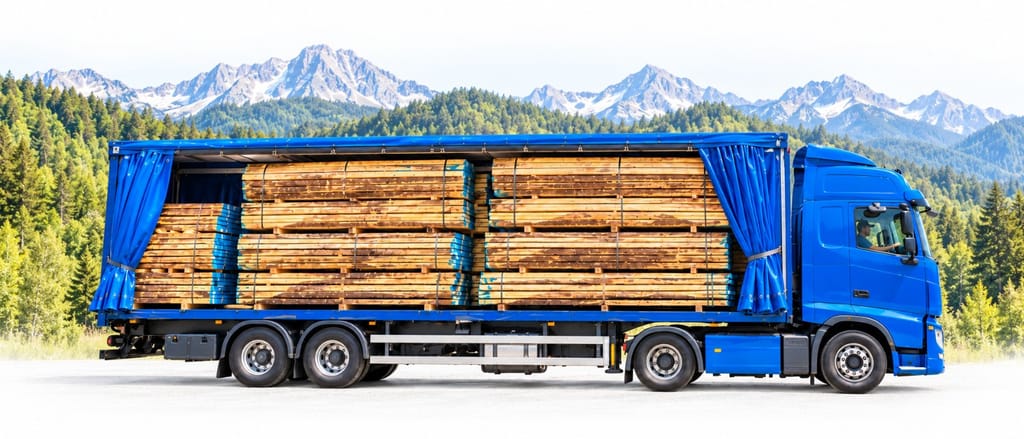
Both. The European markets travel mostly by curtain-side truck; the Middle East, Asia and Africa by container, with a different load preparation.